
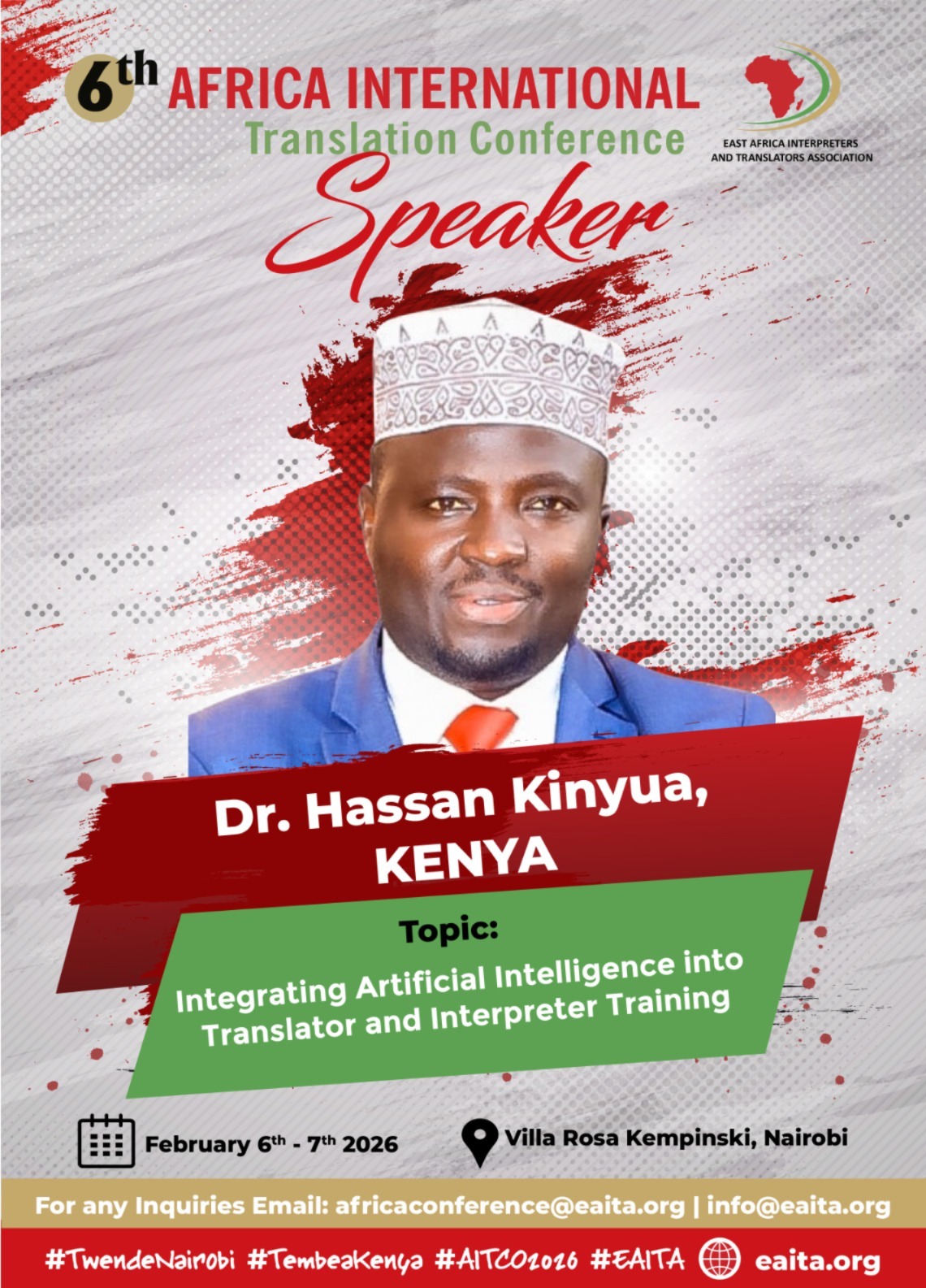
Dr. Hassan Kinyua Omari speaking at the 6th Africa International Translation Conference (AITC 2026), Villa Rosa Kempinski, Nairobi, on the topic “Integrating Artificial Intelligence into Translator and Interpreter Training” (6–7 February 2026).
Nairobi, Kenya – 6–7 February 2026. Dr. Hassan Kinyua Omari represented Kenya as a featured speaker at the 6th Africa International Translation Conference (AITC 2026), held at Villa Rosa Kempinski, Nairobi. The conference was organized by the East Africa Interpreters and Translators Association (EAITA) in collaboration with leading regional language institutions.
Dr. Kinyua delivered a keynote presentation titled “Integrating Artificial Intelligence into Translator and Interpreter Training,” with a broader focus on “Building Capacity through Continuous Professional Development (CPD) in Translation and Interpretation.”
In his presentation, Dr. Kinyua argued that Continuous Professional Development must be treated not as an isolated training activity, but as a structured capacity-building mechanism essential for quality assurance, competence development, and sustainability in language services. Drawing from his professional engagement with the Kenya Institute of Foreign Languages and Professional Studies (KIFLAPS) and the International Jaamia of Languages and Professional Studies (IJLAPS), he emphasized that the translation and interpretation profession is undergoing rapid transformation driven by artificial intelligence, remote interpreting platforms, and computer-assisted translation (CAT) tools.
Key Themes from the Presentation
-
CPD as Capacity Building
Dr. Kinyua clarified that capacity in translation and interpretation is not merely about increasing the number of practitioners, but about ensuring reliable quality at scale—particularly in high-impact domains such as legal, medical, diplomatic, and public communication contexts. -
Integrating Artificial Intelligence in Training
He underscored the importance of integrating AI tools, CAT/QA systems, remote interpreting platforms, and data security protocols into translator and interpreter curricula. CPD, he noted, is the mechanism through which professionals remain current, competitive, and ethically responsible in an evolving digital ecosystem. -
Competence-Based CPD Framework
Dr. Kinyua presented a structured CPD cycle anchored in competence expectations, deliberate practice, feedback loops, mentoring, and portfolio-based evidence of growth. He cautioned against one-off workshops without measurable transfer of skills and advocated for evaluation metrics that go beyond attendance to assess behavioral change and performance results. -
A 12-Month Professional Development Model
The conference presentation outlined a practical annual CPD roadmap: • Q1: Domain competence and terminology extraction
• Q2: Performance improvement through recorded practice and error analysis
• Q3: Technology workflow integration (CAT/QA tools and remote drills)
• Q4: Service professionalism, client communication, and practitioner wellbeing
Each phase emphasized measurable outcomes such as reduced critical meaning errors, improved remote performance, greater terminology consistency, and enhanced client satisfaction.
Professional Contribution and Authorship
Dr. Hassan Kinyua Omari is the author of 38 books, including Foundations of Translation and Interpretation, published by Chance Publishers. The book provides foundational principles in translation theory, interpretation techniques, cultural sensitivity, ethics, and professional standards, serving as a key resource for students and practitioners in the language industry.
As Chairman for Education and Training at EAITA, Dr. Kinyua continues to champion professionalization, standardization, and innovation in translation and interpretation across Africa.
For more information:
- Log in to post comments